

Ending Extreme Poverty by 2030: The Final Push
When World Bank President Jim Yong Kim says that the world can eradicate poverty by 2030, he might sound like he’s flirting with the impossible. Or, he might sound like John F. Kennedy announcing in 1961 that we’ll put a man on the moon before the end of the decade. Intentionally dramatic, and deliberately timed.
“That’s the beauty of a time-bound, ambitious target — it forces you to change,” Kim told the audience in a speech at Stanford Graduate School of Business recently. “Setting time-bound targets is one of the most important steps if you want to achieve ambitious goals.”
He speaks from experience. As the previous director of the World Health Organization’s HIV/AIDS department, Kim spearheaded the ambitious “3 by 5” initiative, which was designed to expand AIDS treatment to 3 million people in developing countries by 2005. “Back then, just about the entire global public health community told us that we were crazy,” Kim says. By establishing the specific goal with a specific timeframe, “we stopped spending all our time arguing about whether treatment was possible and focused on scaling up.”
It’s a lesson he’s bringing to the fight against extreme poverty.
“If you want to do right by the poor, if you want to develop health systems that can do things for poor people’s health that never have been done before, you’ve got to change. And if you want to change a system, setting an ambitious target is a great way to do it.”
Moving the Needle
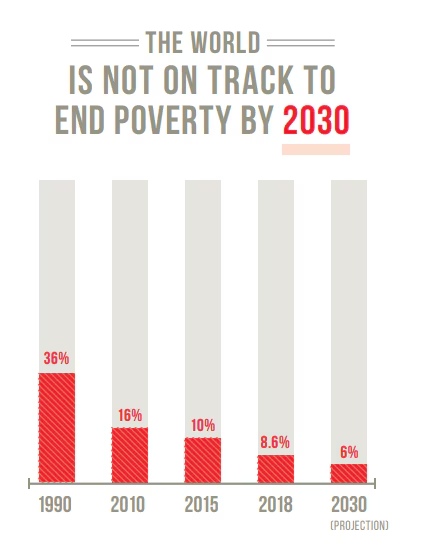
Kim spoke at a Shared Prosperity and Health conference, hosted by the Stanford Global Development and Poverty Initiativeopen in new window. Throughout his speech, he indicated why he thinks his goal is achievable — it’s already happening. In 1990, 36% of the world lived in extreme poverty. While there are 2 billion more people living in the world today, Kim expects that the extreme poverty rate will drop below 10%open in new window for the first time this year. “This is the best news story in the world today,” he says.
But he cautions there are factors working against this goal. He notes that by 2020, half of the extreme poor will live in fragile or conflict-ravaged areas, and the prospects for economic growth in developing countries are the lowest they’ve been in a decade. At the same time, there is easily enough wealth in the world to do away with poverty. “If we just redistributed, we could do it today. But we found that those sorts of approaches where you equalize outcomes haven’t worked well,”
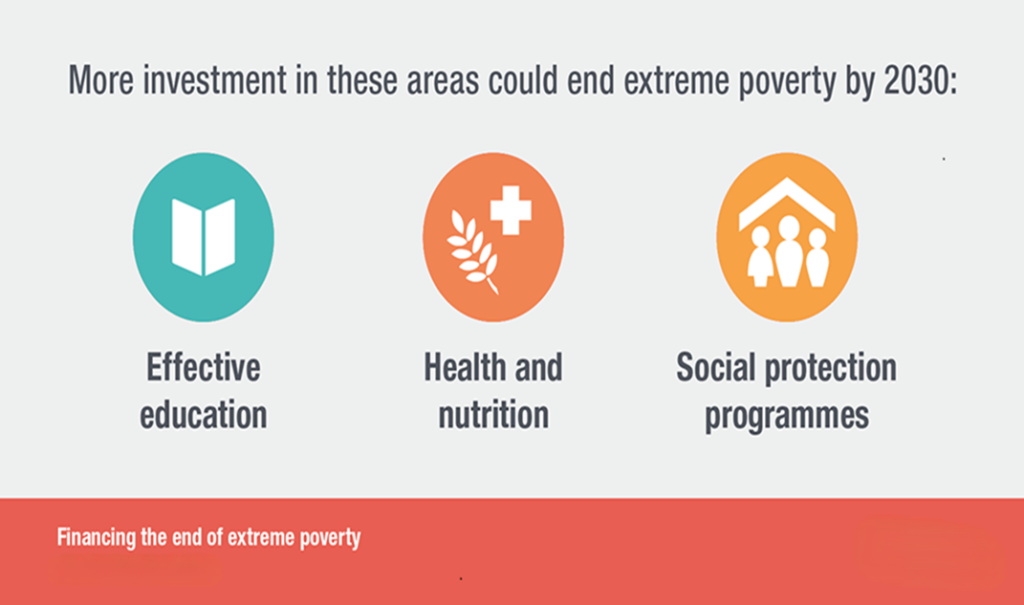
The wiser tactic is to focus on investments — in energy, education, and, most critically, health — that create equality of opportunity and empower communities to break the cycle of poverty, build resilience, and shape their own futures, so that by 2030 we will indeed be the first generation in human history to end extreme poverty, achieve sustainable development goals, improve living standards globally, and promote long-term economic stability and social progress for all.
Refocusing on Health
Promoting growth has always been a priority for the World Bank, Kim says. In fact, at times it has seemed like the institution’s only goal. But growth alone, he says, is not enough to meet the goal of ending extreme poverty. Instead, the institution will target health.
“Evidence is increasingly clear that in addition to growing their economies, developing countries have to make investments in their people,” Kim says. “The most important ones start when a woman becomes pregnant.” He suggests a new goal to drive investments in early childhood development: End childhood stunting
Stunted children are malnourished, understimulated, and at risk for a loss of cognitive abilities. “Children who are stunted by age 5 will not have an equal opportunity in life,” Kim says. “Because if your brain won’t let you learn and adapt in a fast-changing world, you won’t prosper and neither will society. All of us lose.”
Kim says 26% of all children under 5 in developing countries and 36% of children under 5 in sub-Saharan Africa are stunted. “That’s nearly four in ten of sub-Saharan Africa’s children with frankly limited prospects in life. In my mind this is an absolute disgrace. It’s a global scandal.”
Still, Kim says, quick progress is possible. Peru, aided by the World Bank, cut its rate of childhood stunting in half in just eight years, and in 2012 the World Health Assembly, the decision-making body of the World Health Organization, set a goal of reducing by 40% the number of stunted children under 5 by 2025. “That would still leave 100 million children stunted,” Kim says. “This goal, in my view, is not nearly ambitious enough. If equality of opportunity is indeed a value that we all share and we’re serious about boosting shared prosperity, we need to work together to set a target to end the stunting for all children well before 2030,” ensuring healthier futures and stronger economies.
Developing a new investment framework for health care systems will also be instrumental in ending poverty and achieving economic growth, Kim says, citing a 2013 reportopen in new window by the Lancet Commission on Investing in Health, a global group of leading economists and health experts, that determined that the economic return on health investment in low- and middle-income countries could be as high as 10 to 1.
“With the right investments and programs, we can achieve a grand convergence in health outcomes, giving children in Cambodia and California equal chances to survive and live healthy lives.”